
Grid-tied, hybrid, or off-grid inverter: What’s the real difference, and which one do you choose?
You’ve decided to invest in solar panels. You’ve compared quotes, calculated your roof area, and figured out what installed capacity is right for you. And then someone asks you, “Do you want a grid-tied, hybrid, or off-grid inverter?” That’s the moment when most prosumers get stuck. The terms sound technical, the differences seem subtle, and the installer usually recommends what they have in stock—not necessarily what’s right for you.
In this article, we’ll walk through the technical details, “translate” them for you, and explain the real difference between inverters so you can see how each type impacts your daily life. And we’ll help you make the right choice based on your specific situation.
But first: what does an inverter do, in a nutshell?
Solar panels produce direct current (DC). Your home runs on alternating current (AC). The inverter converts DC to AC. Basically, without it, the panels are useless.
But modern inverters do much more than just conversion. They manage energy flows: they decide how much goes to your home, how much to the battery, and how much to the grid. They communicate with the battery, the smart meter, and the monitoring app. And, depending on the type, they may or may not provide backup power during an outage.
The type of inverter you choose determines what your system can and cannot do. It’s the decision that defines your experience as a prosumer.
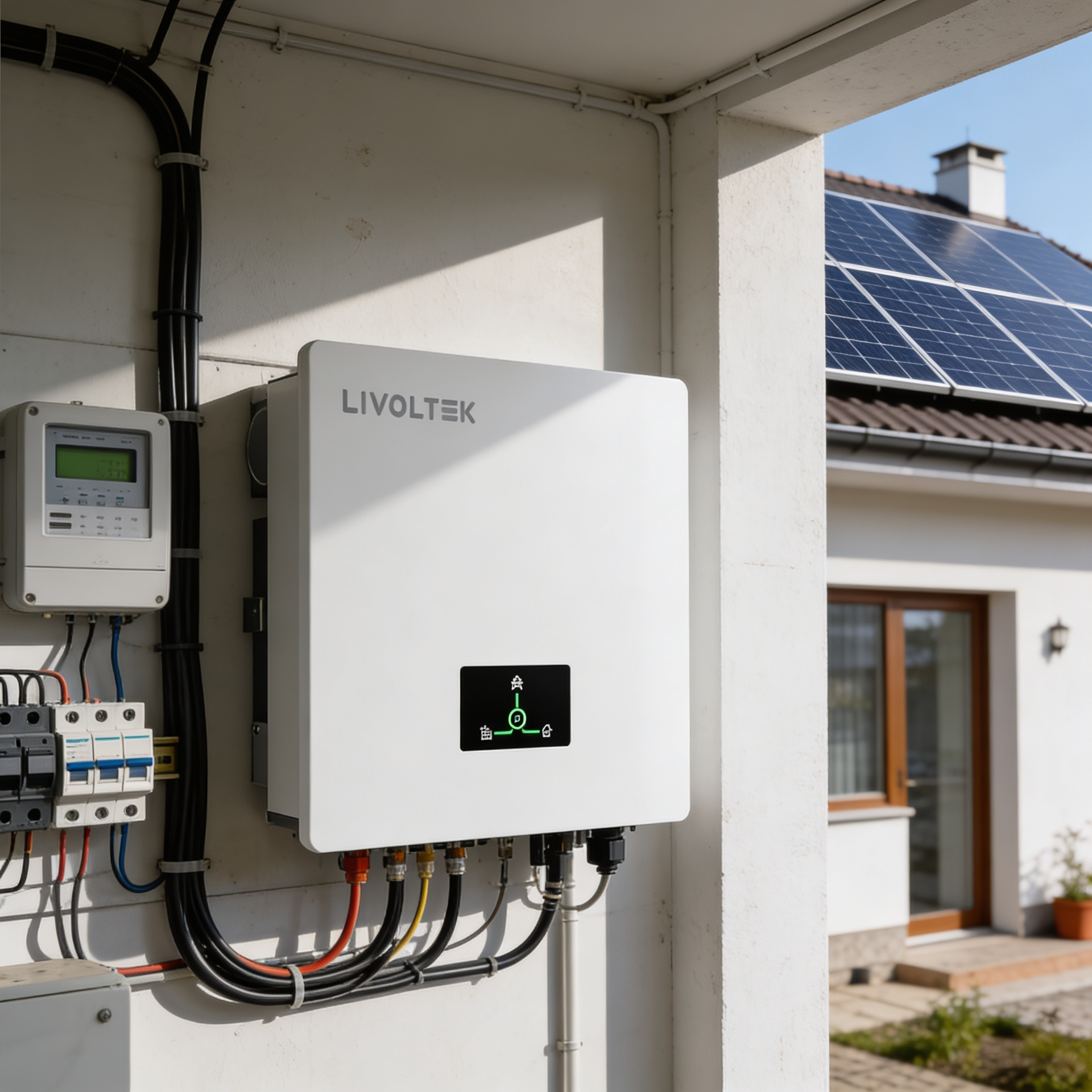
Scenario 1: “I have solar panels and I just want to generate power.” The grid-tied inverter
What is it? In short, it’s an inverter permanently connected to the power grid, whose job is to convert solar energy into alternating current and send it directly to your home. Any power you’re not using at that moment is automatically fed into the grid.
What does it do well? It generates energy with maximum efficiency. Grid-tied inverters are the most efficient on the market (98–99%) because they have a single job: DC→AC conversion, without complications. At the same time, it’s important to know that they’re also the most affordable.
What doesn’t it do? It doesn’t store energy (it isn’t connected to a battery), it doesn’t work during a power outage (it automatically disconnects from the grid for safety reasons—anti-islanding protection), and it doesn’t provide you with energy independence.
The paradox that many don’t understand: you have solar panels on your roof, the sun is shining, but the grid goes down and you’re left in the dark like everyone else. Why? Because the grid-tied inverter is required to shut down when the grid goes out. It’s a safety requirement, because if it continued to generate power, it would endanger the crews working to repair the grid.
Who is it suitable for? For homeowners who want to reduce their electricity bill through direct self-consumption, don’t need a backup, and don’t plan to invest in a battery in the near future. Or for large commercial and industrial projects (over 25 kW) where storage isn’t yet a priority.
Livoltek’s grid-tied GT3 series covers the entire power spectrum, from 1.6 kW (studio apartment, small apartment) to 125 kW (industrial hall), through two complementary series: GT1 (single-phase) and GT3 (three-phase).
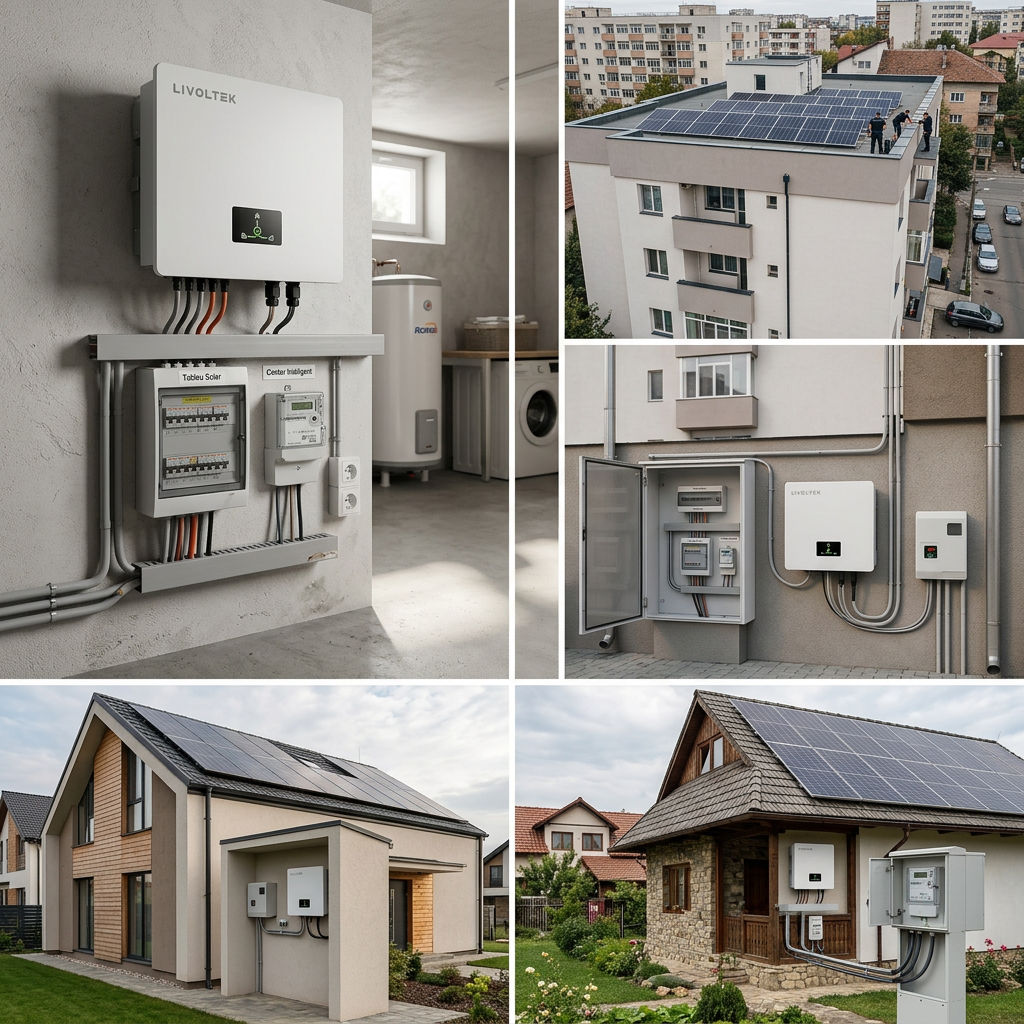
GT1 Single-Phase Series, from 1.6 to 10 kW
- GT1 S1 (1.6–3.3 kW) – the economical mini-inverter for studio apartments and apartments with small PV systems. Single MPPT, conversion efficiency up to 97.8%, dual wireless monitoring (Wi-Fi + Bluetooth), export limitation. Ideal for simple installations under 4 kWp.
- GT1 D2 (2.5–6 kW) — the next step up: two MPPT trackers for dual-orientation roofs, maximum input current of 16A per string (compatible with 182W+ modules), integrated AFCI for arc fault protection. Compact design, suitable for small and medium-sized homes.
- GT1 T2 (7–10 kW) — the most powerful single-phase model in the range: three MPPT trackers, 16A input current per string, integrated SPD II module (surge protection without additional external wiring). For large homes, villas, and small commercial applications on a single-phase grid.
GT3 Three-Phase Series, from 4 to 125 kW
- The GT3 4–25 kW three-phase model is designed for homes and small businesses. It starts up at 160V (ultra-low), which means the inverter starts earlier in the morning and shuts down later in the evening, producing more energy throughout the year. It includes shade tracking management that optimizes production even with partially shaded panels. Optional AFCI module for protection against electrical arc fires.
- The GT3 30–60 kW three-phase model is designed for medium-sized commercial and industrial rooftops. It is compatible with 600W+ modules, features 3–4 MPPT trackers with a precise algorithm, shadow scanning functions, and remote operation and maintenance. Ideal for roofs with mixed orientations.
- The GT3 75–125 kW three-phase inverter is intended for large industrial projects and solar farms. Up to 10 MPPTs (Maximum Power Point Trackers) that independently optimize each string of panels. Maximum input of 40A, compatible with high-current 210+ modules. Innovative design with smart fan cleaning, suitable for industrial environments with dust or sand.
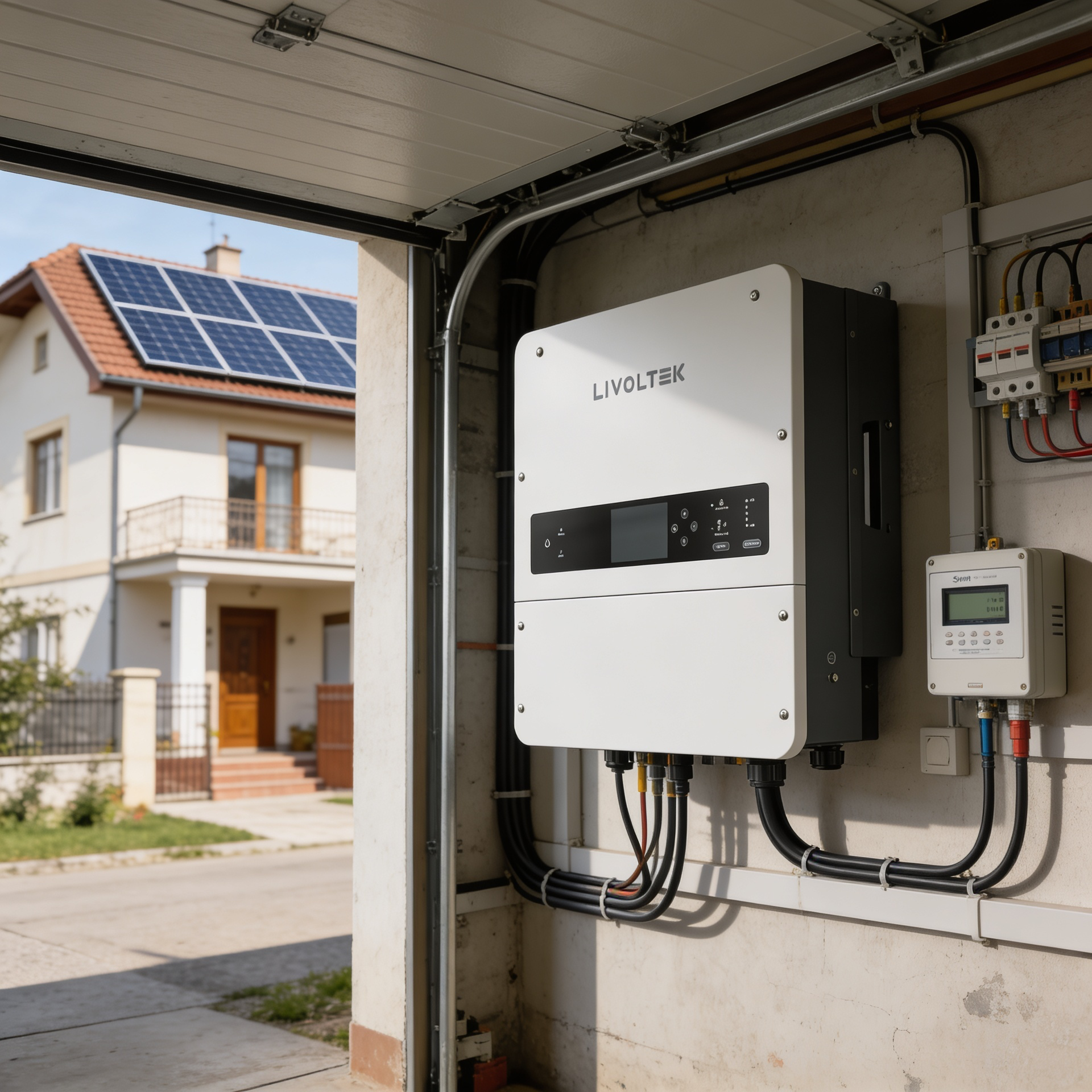
Scenario 2: “I want to generate AND store.” The hybrid inverter
What exactly is it? It’s an inverter that does everything a grid-tied inverter does, but it also manages a storage battery. It remains connected to the grid, but adds a second dimension: storing excess solar energy for later use.
What does it do well? It converts solar energy into AC power for the home (like a grid-tied inverter), charges the battery with the surplus (what you don’t use now is stored), discharges the battery in the evening or at night (when the sun isn’t producing power), and, most importantly, provides automatic backup in the event of a power outage (the EPS, or Emergency Power Supply, function). When the grid goes down, the hybrid inverter switches to battery power in 0.2 milliseconds, imperceptibly to any equipment in the home.
What doesn’t it do quite as well? The pure conversion efficiency is 1–2% lower than that of a dedicated grid-tied system (because it also manages the flow to and from the battery). If we calculate this over the course of a year, the difference amounts to a loss of 30–80 lei—insignificant compared to what you gain through storage.
The difference that really matters: in the morning, the hybrid inverter does exactly what a grid-tied system does—it generates energy. But at noon, when the panels are producing at peak capacity and you’re not home, the surplus doesn’t feed into the grid at half price; instead, it goes into the battery. In the evening, when you get home and turn on the oven, TV, or washing machine, the power comes from the battery, not the grid. And if a storm hits and the power goes out, you won’t even notice.
Who is it for? Anyone who wants true energy independence. Homeowners who want to use as much of what they produce as possible, families with high evening energy consumption, anyone who wants a backup in case of a power outage, and anyone planning to invest in a battery now or in the future (the hybrid inverter is ready to go—just add the battery when you’re ready).
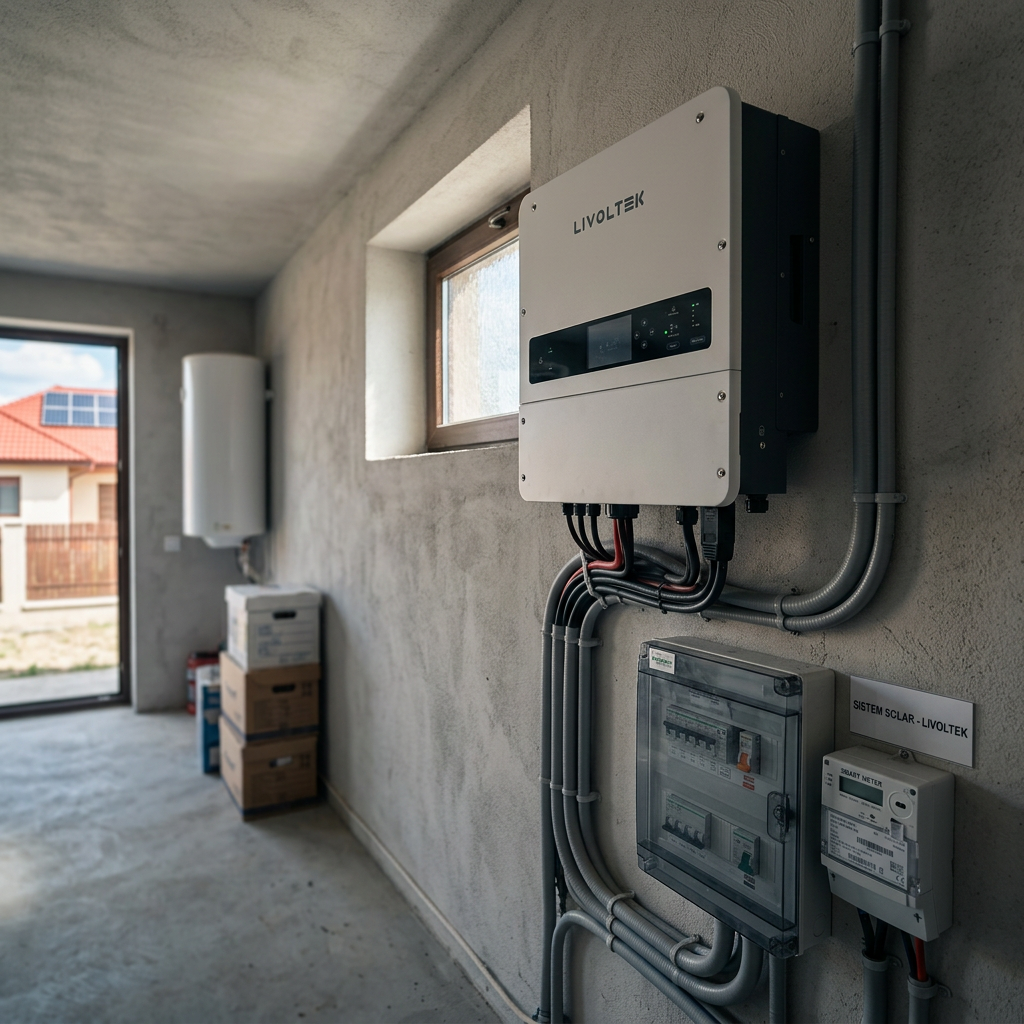
Livoltek Hybrid Series: Covers everything from apartments to medium-sized businesses:
- HP1 3–6 kW single-phase hybrid inverters—for homes, apartments, and small offices. Integrated EPS backup, export control, time-of-use operating modes, scalable modular design (start with one battery, add more later).
- HP1 3–6 kW S2 Series (NEW) – the new generation, with significant improvements: support for parallel expansion of multiple battery sets (not just multiple batteries in a single set, but multiple sets), flexible integration with existing PV systems, and storage from a generator. Livoltek’s response to market feedback: more flexibility, more scalability.
- HP3 5–30 kW three-phase hybrid inverters – for large homes with high energy consumption (heat pumps, electric cars), as well as for the “mid-market” segment: stores, offices, workshops, and small restaurants. Integrated optimized EMS, high-voltage battery storage, strong scalability.
- Single-phase All-in-One ESS 3–6 kW—for those who want the simplest installation possible: a hybrid inverter and low-voltage batteries in a single unit. Plug-and-play, free monitoring via MyLivoltek, compact design. A single unit on the wall, a single cable, a single supplier.
Scenario 3: “I’m completely off-grid.” The off-grid inverter
What is it? It’s an inverter that operates independently of the power grid, so it isn’t connected to the utility company. All the energy comes from solar panels and a battery, and possibly from a backup generator.
What does it do well? It powers a completely self-sufficient home or facility. It includes a built-in solar MPPT (so you no longer need a separate charge controller), requires a battery, can manage a diesel or gasoline generator as a backup source, and offers total grid independence.
What doesn’t it do? It doesn’t feed energy back into the grid (since you’re not connected), so you don’t benefit from net metering credits; therefore, you must carefully size the system’s capacity (if you have three consecutive days without sun and the battery runs out, you’ll be without power unless you have a generator).
The fundamental difference: Off-grid means complete freedom, but with complete responsibility. You don’t have the grid’s safety net, so you need to know exactly how much you consume, how much you produce, how much you store, and have a sufficient buffer for bad days.
Who is it suitable for? Mountain cabins without grid access, isolated farms, sheepfolds, mountain huts, homes in areas where connecting to the grid costs more than an off-grid system, or anyone who wants total energy independence by choice (not out of necessity).
Which Livoltek solution do you use for off-grid systems?
Although Livoltek’s international portfolio includes dedicated off-grid inverters (with integrated MPPT, combined solar and battery charging functions, and Bluetooth/WiFi monitoring), this product line has not been marketed in Romania or, generally speaking, in Europe.
In practice, off-grid installations carried out by Livoltek’s partners in Romania—including at mountain cabins completely disconnected from the grid—use hybrid inverters from the HP1 or HP3 series. These operate natively in off-grid mode, so they manage the solar panels, battery, and generator, provide EPS backup, and offer full monitoring via MyLivoltek.
The major advantage: an HP1/HP3 hybrid inverter can operate both off-grid (completely autonomous) and on-grid (connected to the grid). If the grid is extended to your cabin in the future, you don’t have to replace the inverter—you simply connect it. This is a level of flexibility that a dedicated off-grid inverter does not offer.
But what if I already have solar panels with a grid-tied inverter and want to add a battery?
This is the situation for tens of thousands of prosumers in Romania who have installed photovoltaic systems in recent years, most of them with grid-tied inverters. They all now find themselves in the “I want storage, but I don’t want to throw away my working inverter” scenario.
The solution for them: the Livoltek AC-Coupled system. This isn’t just an inverter, but a complete storage system (battery + integrated inverter) that connects to the AC side of the home, in parallel with the existing grid-tied inverter, and works with any inverter from any brand. The advantages are that you don’t modify anything in the existing installation, you don’t replace the inverter, and you don’t rewire the panel—you simply add a unit next to the panel, connect it, configure it, and you have storage. Basically, AC-Coupled transforms any grid-tied system into a hybrid system without replacing anything you already have.
Decision Tree: How to Choose in 5 Questions
Question 1: Do you already have a photovoltaic system installed with a grid-tied inverter?
If yes: Go with the Livoltek AC-Coupled. Add storage without changing anything.
If no (new installation): Continue to question 2.
Question 2: Do you have access to the power grid?
If not: go with the Livoltek HP1/HP3 hybrid inverter configured in off-grid mode.
If yes: continue to question 3.
Question 3: Do you want or plan to use a storage battery (now or in the near future)?
If not, and you’re not interested in backup power during outages either: go with the grid-tied GT1 (single-phase) or GT3 (three-phase). This is the most efficient and affordable option.
If yes, or even “maybe in 1–2 years”: continue to question 4.
Question 4: Do you want the simplest system possible, without separate components?
If yes: go with the Livoltek All-in-One ESS. A single unit, fully integrated.
If you want maximum flexibility and the ability to expand in the future: continue to question 5.
Question 5: How much power do you need?
Under 6 kW single-phase (studio apartment, apartment, small house): HP1 or HP1 S2 (NEW) single-phase hybrid inverter. Or, if you don’t want a battery: GT1 D2 (2.5–6 kW) or GT1 T2 (7–10 kW) grid-tied system.
6–30 kW (large house, small business): HP3 three-phase hybrid inverter.
Over 30 kW (commercial, industrial): grid-tied GT3 30–125 kW with separate storage (C&I ESS BHF-G or BESS 125 kW/261 kWh batteries).
Mistakes to Avoid
- Don’t choose a grid-tied system if you plan to add a battery in more than two years. You’ll be forced to either replace the inverter (at double the cost) or switch to an AC-coupled system (it works, but you’ll lose a bit of efficiency compared to a hybrid system integrated from the start). If there’s any chance you’ll want storage in the future, choose a hybrid system now, because the price difference is small, but the flexibility you gain is significant.
- Don’t oversize just for “safety”. A 10 kW inverter on a 5 kW panel system doesn’t produce more power—it produces the same amount—but you’ve paid more for the inverter. Proper sizing means matching the panel power to the inverter power, with a margin of 10–20%.
- Don’t ignore the EPS function if you live in an area with an unstable grid. The difference between a hybrid system (with EPS) and a grid-tied system (without) is only noticeable once, but when you do notice it, it makes a huge difference. A full refrigerator, the Wi-Fi router for the kids doing homework, the heating system in winter—they all depend on electricity.
- Don’t choose off-grid “just to be independent” if you have grid access. Choose an HP1/HP3 hybrid inverter with a battery and EPS: you get the same sense of independence, with the grid’s safety net as a backup. And if you ever lose grid access, the inverter still works off-grid.
Conclusion
The three types of inverters aren’t “better” or “worse” when compared to one another. They’re simply suited for different situations.
Grid-tied (single-phase GT1 or three-phase GT3) is the most efficient and affordable option for those who want only solar power generation, without a battery or backup. The hybrid is the most versatile—it generates, stores, provides backup, and scales with your needs. For off-grid systems, in Romania we also use HP1/HP3 hybrid inverters, configured in standalone mode—a solution already proven in real-world installations at mountain cabins. And AC-Coupled is the elegant solution for those who already have a grid-tied system and want to add storage without changing anything.
Choose based on your needs, not on specifications. And if you have any doubts, ask a Livoltek-certified installer in your area. You can find one at https://hexing.ro/distribution-network/.