
How many batteries do you need for an already installed solar panel system?
Do you already have solar panels, but no battery? Then you’ve surely run into the question that stumps everyone: “What battery capacity should I get: 5, 10 kWh, or more?”
It seems like a complicated question, but the answer is surprisingly simple—and you’ll find it in your own data. There’s no need to guess or to buy “the maximum just to be safe.” You just need to see what’s already happening with your energy.
The answer lies in the surplus you’re giving away for free
Here’s the idea in two sentences.
At noon, your solar panels produce more energy than you consume. Since you’re probably at work, the house is empty, and the surplus is fed into the grid, where you sell it at a low price. In the evening, when you return home, you turn on your appliances and buy energy from the grid—but at full price.
The surplus you send to the grid at noon is exactly the energy you could store in a battery and use in the evening. The golden rule is simple: however much you feed into the grid each day is roughly the capacity you need for a storage battery.
There’s no point in buying a larger one, because it would just sit empty. And there’s no point in buying a smaller one, because you’d still be losing energy. The right capacity is the one that “captures” exactly the energy you’re currently wasting.

The 3 Steps to Figuring Out How Much Battery Capacity You Need
Start the process with three relatively easy checks.
Step 1. Find out how much excess energy you feed into the grid each day
You can find this information either in your system’s monitoring app or on your utility bill (where it’s listed as “energy fed into the grid” or “exported”). Look at a typical sunny day and see how many kWh you sent to the grid. That’s your “wasted” energy—the perfect candidate for storage.
Step 2. Calculate how much you consume in the evening and at night
Second check: calculate how much you consume during the time when the solar panels aren’t producing—specifically in the evening and at night (approximately 6:00 PM–8:00 AM). This is where the energy from the battery goes. You can estimate this from your bill or the app.
Step 3. Choose the smaller of the two numbers
The logic is quite simple: the battery can’t store more than the surplus you generate, but it’s also no use to you if it stores more than you consume in the evening. Therefore, the ideal capacity is the smaller of the two values. If you feed 8 kWh of surplus into the grid but consume only 6 kWh in the evening, you need a battery of ~6 kWh. If you feed 5 kWh of surplus but consume 9 kWh in the evening, you need ~5 kWh (because you wouldn’t be able to charge it beyond that anyway).
Three concrete examples
To make it easier to understand, here’s how the calculation works. You’ve seen some rough estimates above, but keep in mind that your actual figures—from the app or your bill—are always more accurate than any average or estimate. They do, however, give you an idea of the order of magnitude.
- 3 kW solar panel system (small house, couple, modest consumption). On a sunny day, it produces around 12–18 kWh. Of that, if you’re away during the day, you feed about 5–8 kWh back into the grid. Evening consumption is moderate. The right battery: around 5 kWh, which is exactly the basic module.
- 5 kW solar panel system (average family, typical home). It generates around 20–30 kWh on a sunny day, with a surplus of 8–12 kWh fed into the grid. Evening consumption is medium to high. Suitable battery: around 10 kWh.
- 8 kW solar panel system (large home, high consumption, possibly a heat pump). Generates 32–45 kWh on a sunny day, so you feed approximately 12–18 kWh into the grid. High evening consumption. Suitable battery: 15 kWh or more.
The Benefits of the Modular System
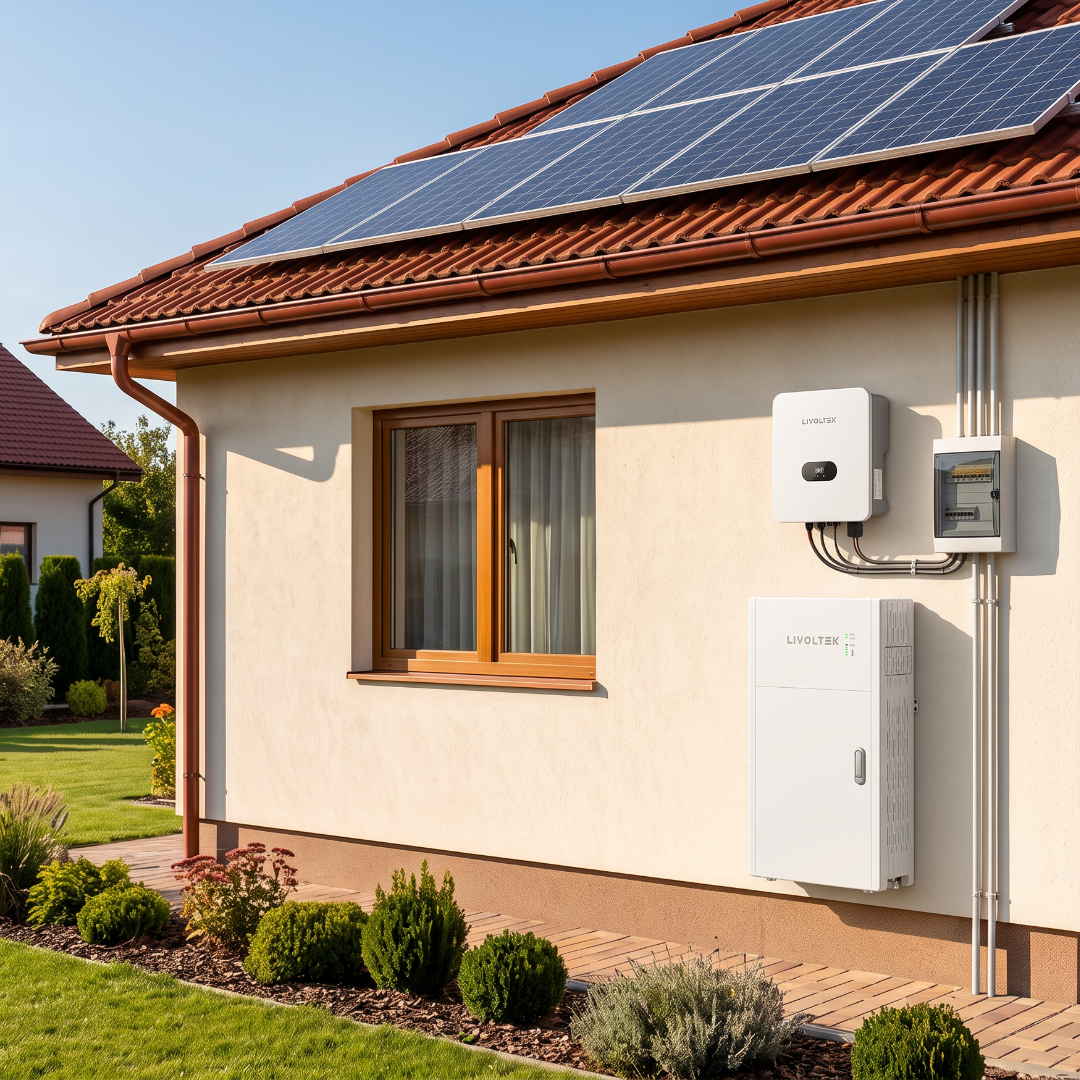
We have more good news. You don’t have to make a decision right away, because the Livoltek solution is modular—meaning it can grow with you.
AC-Coupled Livoltek is the perfect solution when you already have solar panels and a working inverter. In that case, AC-Coupled simply gets added next to the electrical panel without changing anything in your existing setup. It connects to the AC side and works with any inverter, regardless of brand. In practice, you’re turning your grid-tied system into one with storage, without having to get rid of anything you already have.
And the battery starts with a small capacity and scales up modularly. Livoltek batteries are built from modules. For example, the BLF series comes in 5.12 kWh modules that can be stacked as needed. You start with what you need now and add modules later if your needs grow (you switch to an electric car, an electric heating system, or simply add more high-power appliances).
To put it simply, you don’t lose anything by starting with a “conservative” setup. If your current excess production justifies 5 kWh, you get 5 kWh. In two years, if the situation changes, you can add more. You’re not locked into a decision made today for needs ten years down the line.
If you need high capacity right from the start, Livoltek also offers dedicated solutions, such as the BHF series batteries (5–30 kWh) or the new 16 kWh HomeCellar, designed specifically for families with high energy needs.
The Rule of Sizing for Actual Surplus
The temptation is to get as much capacity as possible, just to be on the safe side. But an oversized battery means money wasted: if your daily surplus production is 6 kWh, a 15 kWh battery will only fill up halfway each day. So, you’re paying for capacity you never use.
Sizing for actual surplus means that every kWh of battery capacity you buy actually works for you—it charges and discharges daily, so it delivers daily savings. This is the investment that pays for itself the fastest.
And if your situation changes, you can simply add more modules.
Conclusions
The first conclusion is that you don’t have to guess how much battery capacity you need. Your system already tells you—just look at the surplus you feed into the grid and your evening consumption. The smaller of the two numbers is your starting point.
Second conclusion: since it’s a modular solution, with AC-Coupled Livoltek you don’t even have to get it perfectly right the first time. You start with what you need now and add more later if necessary—without changing the inverter, without rewiring the system, and without paying for capacity that goes to waste.
The easiest way to put it all together is a few-minute discussion with a Livoltek-certified partner. You can find them at https://hexing.ro/distribution-network/ , and details about the AC-Coupled solution and the battery lineup are available at https://hexing.ro/our-products/ .
The right battery isn’t the biggest one. It’s the one that captures exactly the energy you’re currently wasting.