
5 Types of Businesses That Lose Money Every Day Without Energy Storage
Somewhere in Romania, a bakery oven turns on at 3:00 a.m. A cold storage compressor kicks in at a supermarket. A pressure pump starts up at a self-service laundromat. A hotel’s air conditioning begins cooling 40 rooms. All of these devices have something in common: they consume a lot of energy, sometimes at inconvenient hours, and often generate power spikes that are painfully reflected in the monthly bill. And their owners pay more than they should every month because they lack energy storage.
But let’s not talk about technology, since we often cover that in our articles. Let’s talk about money instead. About five types of businesses that are losing concrete, quantifiable, significant amounts of money every month. And above all, let’s talk about how a photovoltaic system with storage can stop those losses.
1. Bakeries and pastry shops: ovens at 3:00 a.m., bills at 3:00 p.m.
Consumption Profile: An average bakery in Romania operates industrial electric ovens (installed power of 30–80 kW per oven), mixers (5–15 kW), climate-controlled proofing chambers (2–5 kW, running non-stop), and refrigeration for raw materials (5–10 kW, running non-stop). Average total consumption ranges from 100 to 250 kWh per day, depending on production capacity, which translates to 3,000–7,500 kWh per month.
The Specific Problem: The bakery starts production between 3:00 and 4:00 a.m., a time when energy costs are high on the spot market and when the solar panels are not generating any power. When the ovens are started simultaneously, consumption jumps from 15–20 kW to 60–80 kW in a matter of seconds. These power peaks are recorded over a 15-minute interval and determine the contracted power component on the bill (which is paid monthly), regardless of whether the peak lasted 5 minutes or 5 hours.
How does a system with solar panels and storage solve this problem?
The photovoltaic panels on the warehouse roof (typical area of 200–500 square meters, ideal for PV) generate energy during the day, and the battery stores it for nighttime use. The BESS discharges the stored energy starting at 3:00 a.m., powering the furnaces from the battery instead of the grid. At the same time, it performs peak shaving when equipment starts up, maintaining the apparent power consumption from the grid at a constant level and eliminating power spikes.
Suitable Livoltek Equipment: For a medium-sized bakery, a 30–50 kW PV system with GT3 grid-tied inverters (three-phase, 30–60 kW) combined with a 125 kW/261 kWh BESS. Large bakeries can scale up to 2–3 BESS units in parallel.
Estimated annual savings: with an average consumption of 5,000 kWh/month and an electricity price of 1.50 lei/kWh, solar self-consumption can cover 30–40% of daytime consumption (savings: 27,000–36,000 lei/year). Peak shaving can reduce the power component by 20–30% (additional savings: 5,000–15,000 lei/year, depending on the contracted power rate). Estimated total: 32,000–51,000 lei/year, with a payback period of 4–6 years.
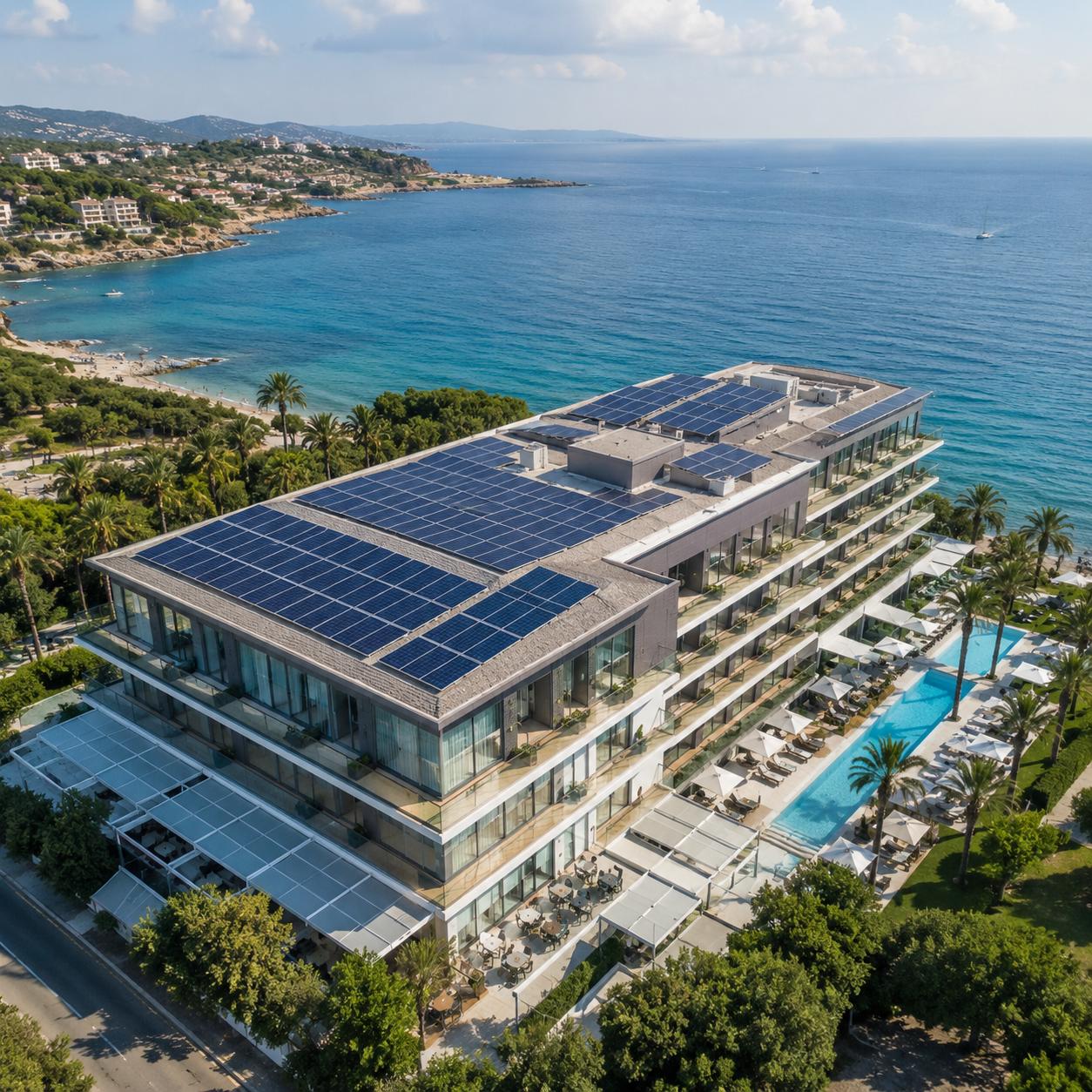
2. Hotels and guesthouses: evening consumption, round-the-clock reputation
Energy Consumption Profile: An average hotel in Romania (30–60 rooms) consumes between 150 and 400 kWh per day. The main energy consumers are air conditioning (40–60% of the summer bill, with peaks of 30–60 kW), lighting (rooms, hallways, exterior—10–20 kW around the clock), the commercial kitchen (ovens, range hoods, refrigerators—15–30 kW), circulation pumps and water heaters (5–15 kW), elevators (short peaks of 10–20 kW), and IT systems (reception, key cards, Wi-Fi—3–8 kW non-stop).
The specific problem: the hotel consumes the most energy precisely when the solar panels aren’t producing, i.e., in the evening and at night. Guests return from their excursions at 6:00 PM, turn on the AC, take a shower, and head down to the restaurant. Energy consumption skyrockets between 6:00 PM and 11:00 PM. In the morning at breakfast, ovens and espresso machines generate another peak. And in the summer, the AC runs practically non-stop, with peaks during the hottest hours (12:00 PM–4:00 PM).
And the real problem isn’t just the energy bill. Reputation is also at stake. A 2-hour power outage in a fully booked luxury hotel means: stuck elevators, an inoperable key card system, a restaurant in darkness, refrigerators shut off, dissatisfied guests, and negative reviews. BESS switches over in 0.2 milliseconds, so a power outage goes completely unnoticed.
How does a system with solar panels and storage solve the problem?
Panels on the roof or parking canopy generate maximum power at noon (in the summer), exactly when the AC is consuming the most. This is the perfect match for direct self-consumption. The surplus is stored in the battery for the evening and night, and the BESS performs peak shaving when the AC and elevators start up. Bonus: it provides instant backup in the event of a power outage.
Suitable Livoltek equipment: HP3 three-phase hybrid inverters (5–30 kW) or GT3 grid-tied inverters (30–60 kW) with C&I ESS BHF-G batteries (15–60 kWh per rack) for small hotels/inns, or a 125 kW/261 kWh BESS for medium-to-large hotels.
Estimated annual savings: with an average consumption of 8,000 kWh/month, solar self-consumption (30–50 kW PV) covers 25–35% of consumption (savings: 36,000–50,000 lei/year). Peak shaving: 5,000–12,000 lei/year.
The value of the backup is difficult to quantify, but a single power outage handled correctly can save tens of thousands of lei in lost reviews and future bookings. Estimated total direct savings: 41,000–62,000 lei/year.
3. Supermarkets and grocery stores: cold storage rooms never shut down
Energy consumption profile: An average supermarket in Romania (400–1,000 square meters) consumes between 200 and 500 kWh per day. Cold storage rooms and refrigerated display cases are the dominant energy consumers: 50–70% of the total bill, operating 24/7, with a constant consumption of 15–30 kW plus peaks of 40–60 kW during defrost cycles and when compressors start up. Lighting (10–20 kW, 12–16 hours/day), air conditioning (15–30 kW in the summer), and cash registers plus IT systems (3–8 kW) round out the picture.
The Specific Problem: The supermarket has two distinct energy issues. The first is the consistently high power consumption of the cold storage rooms, which operate nonstop and cannot be shut down. The second is the power surge when the compressors start up. A cold storage compressor can have a starting current 3–5 times higher than its rated current. When 2–3 compressors start simultaneously (after a defrost cycle, for example), the power peak jumps to 100–150 kW for a few minutes. These peaks determine the contracted power component, which is billed monthly.
Furthermore, a 4-hour power outage in a supermarket with a cold storage room at -18°C can result in the loss of the entire stock of frozen products. In an average supermarket, the value of perishable inventory is considerable, in the tens or hundreds of thousands of lei. A single prolonged power outage can lead to major losses.
How does a solar panel and storage system solve this problem?
A supermarket’s roof (400–2,000 square meters, flat, unobstructed) is the ideal surface for PV. Solar power generated at noon directly powers the cold storage rooms and the air conditioning (maximum consumption in summer = maximum PV output). The BESS performs peak shaving when the compressors start up and provides critical backup power for the cold storage rooms during a power outage.
Suitable Livoltek equipment: GT3 grid-tied inverters (30–125 kW, depending on the PV area) with a 125 kW/261 kWh BESS. Large supermarkets can scale up to 2–4 BESS units.
Estimated annual savings: with an average consumption of 10,000 kWh/month, solar self-consumption (50–100 kW PV on a flat roof) can cover 30–45% of consumption (savings: 54,000–81,000 lei/year). Peak shaving on compressors: 8,000–20,000 lei/year. Estimated total direct savings: 60,000–100,000 lei/year, not including savings from avoiding inventory losses.
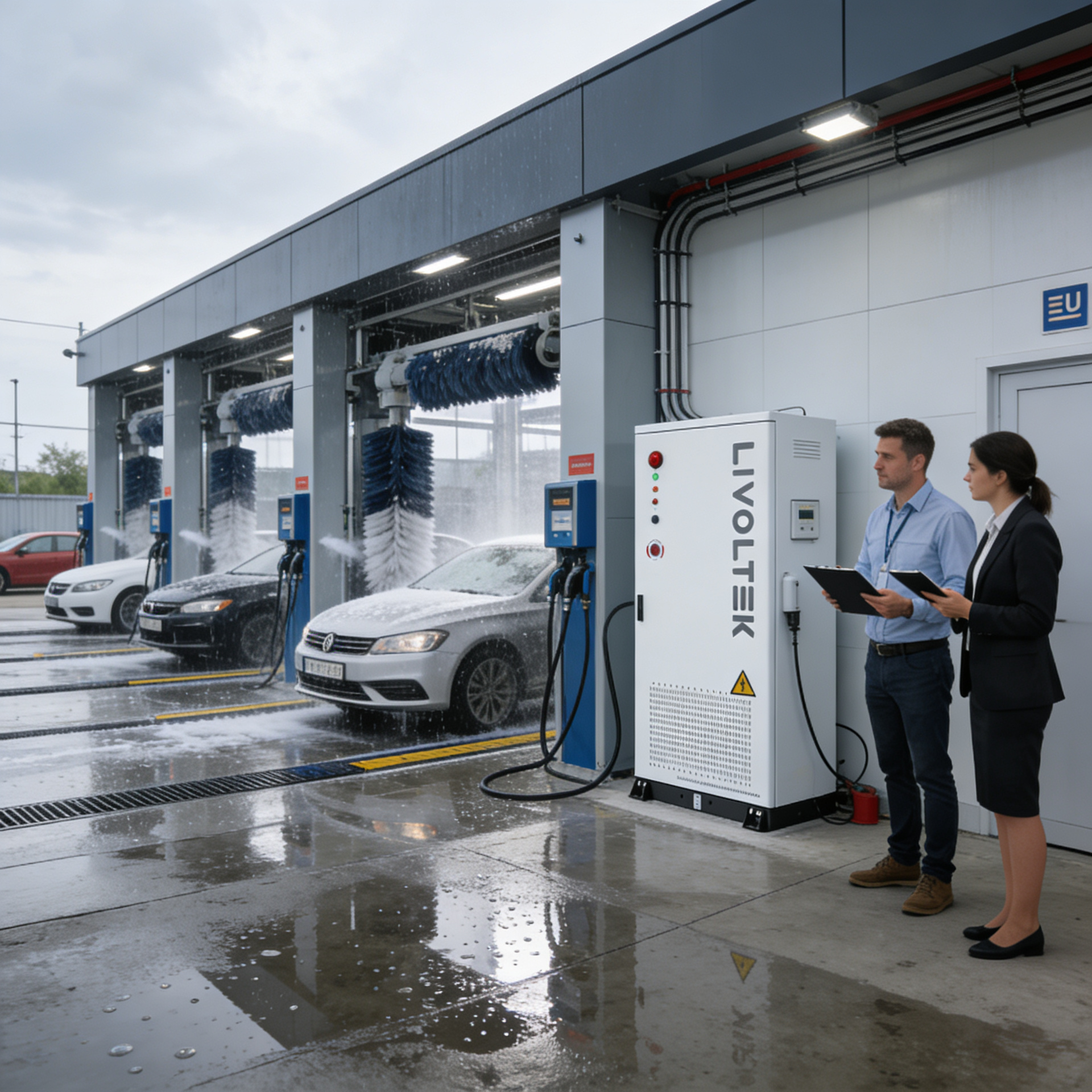
4. Self-service car wash: 40 kW peaks lasting 7 minutes
Consumption profile: A self-service car wash with 4–6 bays consumes between 80 and 150 kWh per day. Consumption is driven primarily by high-pressure pumps (7–15 kW per bay), industrial vacuum cleaners (2–3 kW per bay), water heating (15–30 kW), outdoor lighting (3–8 kW, nighttime operation), and the water recirculation system (2–5 kW continuously).
The specific problem: the energy consumption of a self-service laundromat is unpredictable and occurs in “spikes.” A customer arrives, turns on a station—12–15 kW for 5–7 minutes. Three customers arrive simultaneously (on a Saturday morning)—40–50 kW for 7 minutes. Then 20 minutes of quiet. Then another peak. These short but repeated peaks result in a contracted power capacity that is disproportionately high compared to total consumption. The laundromat consumes relatively little per month (2,500–4,500 kWh), but pays for contracted power as if it were a business twice as large.
Furthermore, self-service laundromats operate primarily on weekends and on sunny days—exactly when solar production is at its peak. It’s an almost perfect match.
How does a system with solar panels and storage solve this problem?
Photovoltaic panels on the awning roof (typical area 100–200 square meters) produce maximum power exactly when customer traffic is highest (weekends, good weather). The battery performs peak shaving every time a pump starts, keeping grid consumption constant. At night, the battery powers the lighting and the recirculation system.
Suitable Livoltek equipment: HP3 three-phase hybrid inverters (10–20 kW) with BHF High Voltage batteries (10–30 kWh) for small car washes, or GT3 inverters (25–50 kW) with C&I ESS BHF-G (30–60 kWh) for larger car washes. Bonus: Adding a Livoltek EV charging station (AtomAC or BUSH) turns customer wait time into additional revenue.
Estimated annual savings: With an average consumption of 3,500 kWh/month, solar self-consumption covers 40–55% of consumption (savings: 25,000–35,000 lei/year—the percentage is higher than for other businesses because solar production coincides with peak usage). Peak shaving: 3,000–8,000 lei/year (significant reduction in the power component relative to total consumption). Additional revenue from the charging station: variable, 5,000–15,000 lei/year depending on traffic. Estimated total: 33,000–58,000 lei/year.
5. Farm and Greenhouse: Midday irrigation, round-the-clock climate control, seasonal processing
Consumption Profile: An average farm with greenhouses in Romania consumes between 100 and 300 kWh per day, with extreme seasonal variations. Summer: greenhouse climate control (fans, humidifiers, motorized screens—20–50 kW), irrigation pumping (10–30 kW, with start-up peaks), cold storage rooms for harvest storage (10–20 kW, 24/7). Winter: supplemental artificial lighting (10–30 kW, 8–12 hours/day), greenhouse heating (if electric, 30–80 kW). Year-round: primary processing (sorting, packaging, washing—10–20 kW per shift).
Specific issue: The farm has an untapped advantage and a major vulnerability. The advantage is that irrigation operates at midday (the hottest hours of the day = maximum evapotranspiration = maximum solar production). This is the best natural match between solar energy production and consumption across all five categories. The vulnerability: many farms are located in rural areas with an unstable power grid. Power outages are frequent, and 4–6 hours without electricity for irrigation on a 38°C day can jeopardize an entire harvest.
How does a system with solar panels and storage solve this problem?
Photovoltaic panels on greenhouse roofs or on adjacent land (the farm usually has sufficient space) produce maximum power exactly when irrigation consumption is at its peak, thus achieving nearly 100% direct self-consumption at noon. The battery stores the surplus for nighttime greenhouse climate control and for powering the cold storage rooms. The BESS provides critical backup during power outages, protecting the crop.
Suitable Livoltek equipment: GT3 grid-tied inverters (25–125 kW, depending on the PV area) combined with C&I ESS BHF-G batteries (30–60 kWh) for small farms or a 125 kW/261 kWh BESS for large farms. All Livoltek products use LiFePO4, which is eligible under AFIR requirements.
Estimated annual savings: with an average consumption of 6,000 kWh/month, solar self-consumption can cover 40–55% of consumption (savings: 43,000–59,000 lei/year; the high percentage is due to the natural alignment of production and consumption). Peak shaving: 3,000–8,000 lei/year.
Crop protection during power outages: difficult to quantify, but a single compromised harvest can result in significant losses. Estimated total direct savings: 46,000–67,000 lei/year.
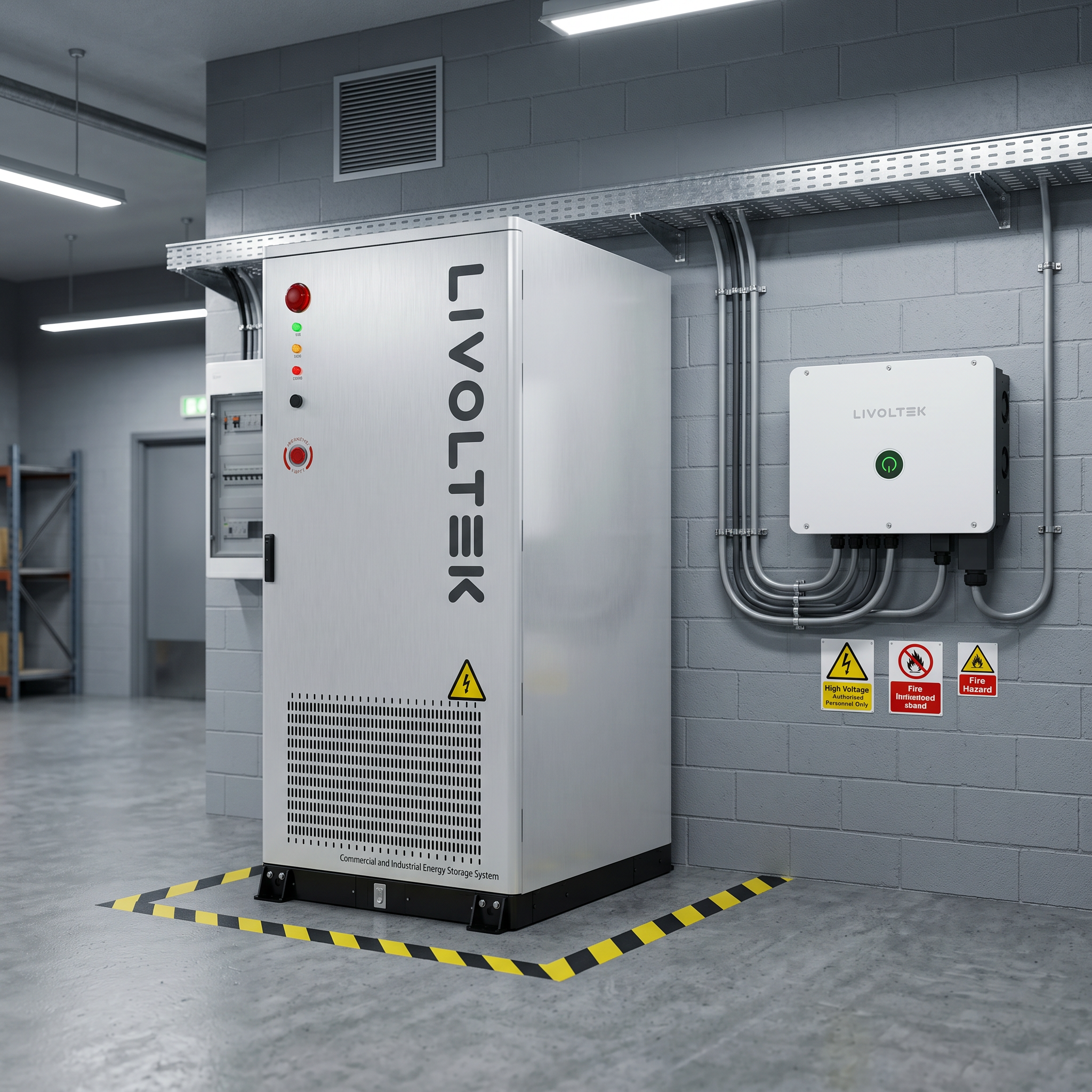
The calculation we should be making
The cost of energy is shown on the bill. The cost of storage is shown in the price quote. But the cost of not having storage isn’t shown anywhere, and that’s exactly why it’s ignored.
What does it consist of? Well, theory says it consists of the difference between the export price of the solar surplus and the evening import price (which you pay for nothing if you had stored the energy), the contracted power component inflated by short-term peaks (which you could have reduced by 20–30%), losses resulting from power outages (cold storage rooms in supermarkets, hotels, and farms), production losses during outages (bakeries, workshops), reputational losses (hotels, restaurants), and penalties for reactive power (common among industrial consumers with motors and compressors).
When added up over a year, these hidden costs often exceed the payback period of a storage system. In other words: the battery pays for itself with the money you’d be losing anyway.
The Next Step
Each of the 5 business types listed above can request a free analysis from the Livoltek team or a certified partner in the local network. The analysis is based on your actual bills from the last 12 months and generates a concrete calculation: how much you’ll save, how many years it will take to recoup your investment, and what financing options are available to you.
Find one of the certified installers in your area: hexing.ro/ro/parteneri-livoltek, and let’s run the numbers for your business!