
Motion Fast DC 160-240 kW: How to Turn a Parking Lot into a Profitable Charging Station
For gas stations, hotels, or shopping centers with large parking lots, turning the parking lot into a profitable business by harnessing energy is no longer a dilemma—the only question is when it will happen. The pressure is coming from all directions: the number of electric cars is growing, customers are asking about it, competitors are already installing charging stations, and European regulations are pushing in the same direction.
But between “I should do something” and “I’ve done something profitable” lies a gap filled with unanswered questions. How much power do I need? How much does it cost? Won’t my energy bill skyrocket? And, most importantly, does it actually make money, or is it just an expense for the sake of image?
This article answers it all. Specifically, with numbers. Let’s take them one by one!
Why Your Parking Lot Is, in Fact, an Untapped Asset
Think about what you already have: a space where cars park anyway. At a gas station, drivers stop anyway. At a hotel, the guest’s car stays parked all night. At the mall, the car stays parked for as long as the shopping takes. At a logistics center or a transit parking lot, vehicles stay parked for hours on end.
Each of these minutes of parking is, potentially, charging time. And charging time, at high power, means revenue. A regular parking lot produces nothing; it’s a cost (land, development, security). A parking lot with fast-charging stations becomes a source of revenue that operates 24/7, even while you sleep.
The difference between the two lies in a single word: speed. And that’s where the right technology comes in.
Speed changes everything: why ultra-fast DC charging matters
Not all charging stations are the same, and the difference is huge when it comes to profitability.
A slow AC station (7–22 kW) charges a car in 4–8 hours. It’s suitable for home use or for places where the car stays all day (office, overnight at a hotel). But at a gas station or a transit parking lot, no one stays for 6 hours. There, a slow station is commercially useless.
An ultra-fast DC station completely changes the equation. With Livoltek’s Motion Fast DC, at power levels of 160–240 kW, an electric car charges in about 15–20 minutes—the time it takes to grab a coffee and run a quick errand. This means that the same charging station can serve not just one, but several customers per hour.
The math is simple: a slow charging station serves 2–3 cars per day. An ultra-fast charging station can serve 15–25 cars per day at the same location. High customer turnover is what turns a charging station from an expense into a business.
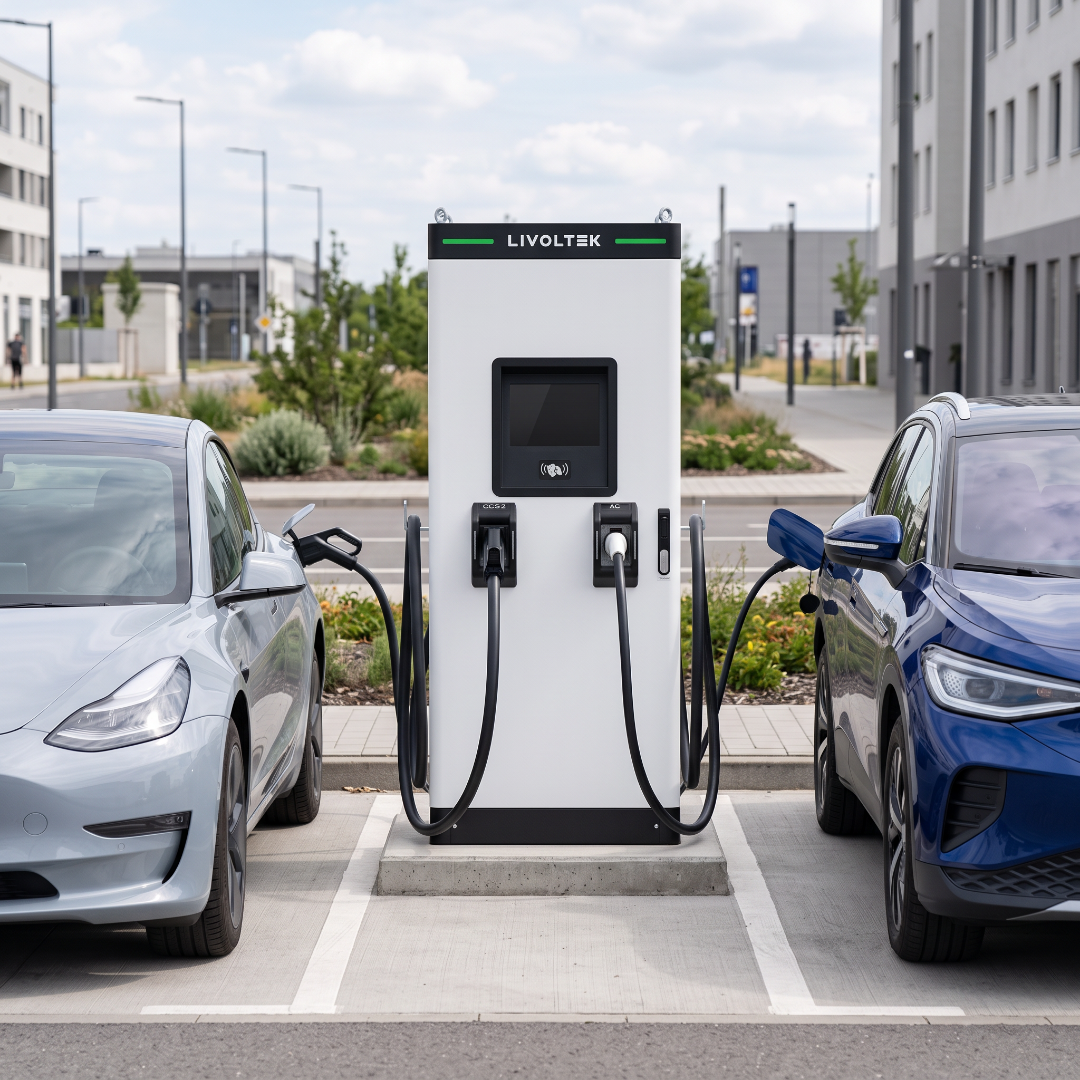
Motion Fast DC 160–240 kW: What It Is and Who It’s For
Livoltek’s Motion Fast DC is a stand-alone (independent) charging station designed specifically for high-traffic commercial locations: gas stations, shopping centers, hotels, transit parking lots, and logistics hubs. Here are the features that matter most to an operator:
· Ultra-fast, scalable power. The station has a modular design, with power modules that can be configured from 60 kW up to 240 kW. You can start with a lower power output and add modules as demand grows—you invest based on traffic, not on speculation.
· Two simultaneous outputs. The station has two DC outputs and can be configured with CCS2 and GB/T connectors, so it supports virtually any electric vehicle on the market. Two vehicles can be charged in parallel, doubling the service capacity.
· Efficiency and robustness. With a conversion efficiency of over 96%, losses are minimal. The station operates within an extremely wide temperature range, from -30°C to +50°C, so it runs reliably in winter in Transylvania and in summer on the coast, without the need for an additional climate-controlled enclosure. The noise level is below 65 dB, which is acceptable in commercial and residential areas.
· Authentication and management. Customers authenticate via an RFID card or an app, which means you can accurately bill each charging session. The station integrates with the Livoltek Energy Management System (IEMS), featuring remote monitoring.
For locations with mixed traffic, there’s also the 82 kW Motion Fast DC variant (60 kW DC plus optional 22 kW AC), which combines fast charging with AC charging for vehicles that stay longer—useful at hotels or offices where you have both types of customers.
The Hidden Challenge: the Electrical Connection
This is the pitfall many operators fall into, and one that few discuss before making a purchase. A 240 kW station requires 240 kW of power from the grid. If you add two such stations, you need nearly 500 kW of available power at the connection point. The problem? Most gas stations, hotels, and parking lots don’t have that much contracted power. And upgrading the electrical connection (increasing the power available from the utility) costs money and can take months, involving permits, designs, and grid work. For many, this barrier turns the project from “profitable” to “impossible.”
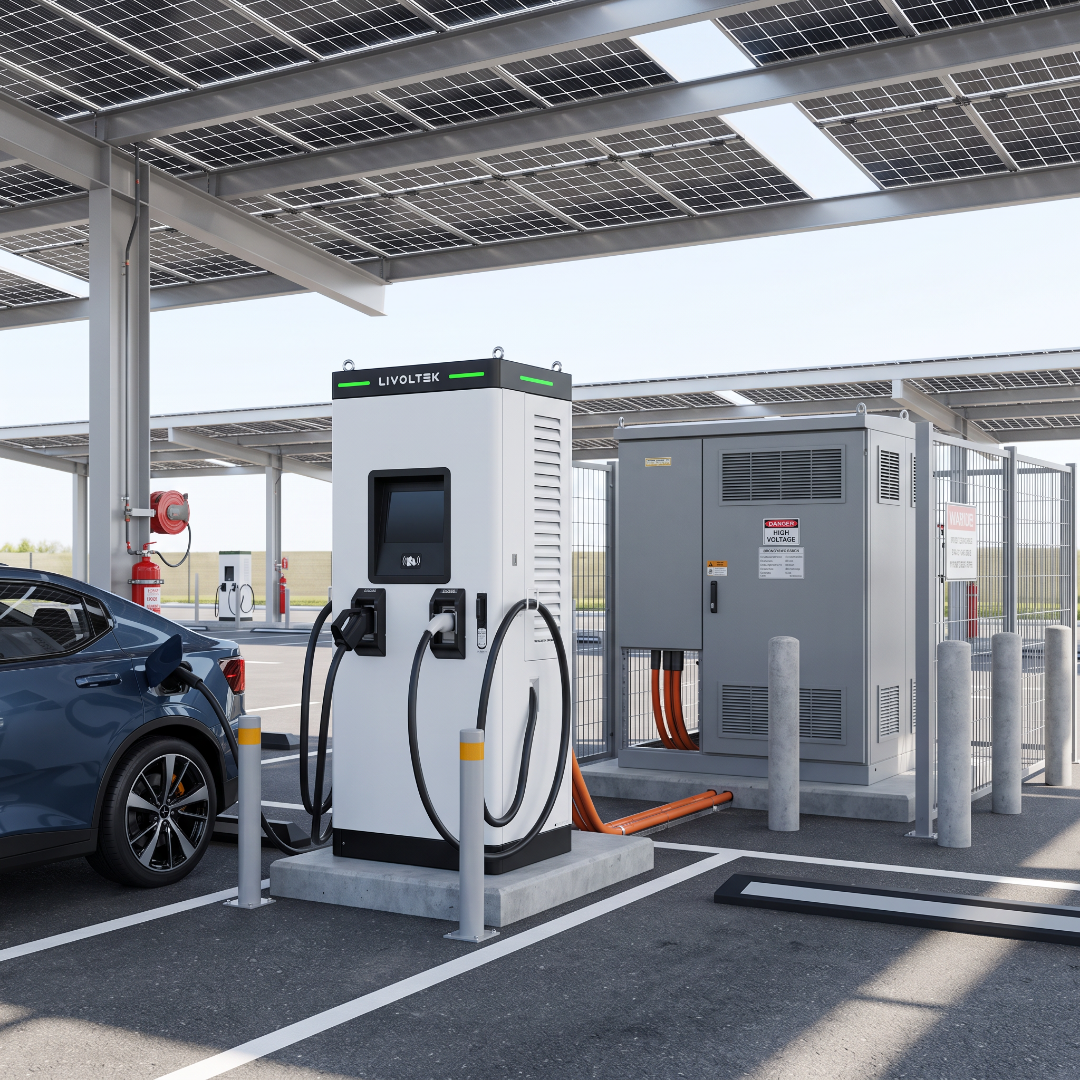
Livoltek’s solution is a smart combination of a charging station, solar panels, and an industrial energy storage system (BESS). Here’s how it works:
· Solar panels—mounted on the gas station canopy, the mall roof, or parking lot shade structures—generate energy during the day at the lowest cost.
· The Livoltek BESS (for example, the 125 kW/261 kWh unit) stores this energy and quickly “releases” it when a car connects to charge. The battery acts as a buffer between the grid and the charging station.
The result: instead of suddenly drawing 240 kW from the grid with every charge—which would require a massive connection—you constantly draw a small amount of power from the grid to charge the battery, and the battery delivers the peak power to the car. This way, you can operate ultra-fast charging stations without expanding your connection, or with a much smaller expansion.
That’s the difference between a project stuck in the permitting process for months and one that gets up and running in a few weeks. Plus, there’s an added benefit: some of the energy sold to customers comes from your own solar panels, at nearly zero cost, which increases the profit margin on every kWh sold.
How exactly does it become profitable?
The business model is straightforward. You buy energy from the grid during off-peak hours, from your own panels, or from a battery, and sell it to customers at a charging rate. The difference is your profit margin.
With healthy turnover (let’s say 15–20 charging sessions per day per station, averaging 30–40 kWh per session), we’re talking about hundreds of kWh sold daily per station. The margin per kWh, combined with the fact that some of the energy comes from PV at minimal cost, plus indirect revenue (customers who stop to charge buy coffee, eat, or shop), makes this a reasonably profitable investment.
Indirect revenue is often underestimated. A customer who stays 20 minutes to charge their car at your gas station is a captive customer who will buy something from the store. For a mall, electric vehicle drivers are a customer segment with above-average purchasing power, which you attract precisely through the availability of fast charging. For a hotel, the availability of charging becomes a booking criterion.
And with the continuous growth in the number of electric cars, a charging station installed today becomes more and more profitable with each passing year. Demand is growing, and your infrastructure is already in place.
Funding Available for Charging Stations
The good news: you don’t have to cover the entire investment on your own. There are dedicated funding programs, and the key is to choose the one that best fits your profile. Here is the current, verified overview.
The main program for commercial operators is e-MOVE RO, a scheme run by the Ministry of Transport and Infrastructure and funded through the Modernization Fund. e-MOVE RO targets charging infrastructure on public roads outside the network of highways and major national roads—specifically locations such as city gas stations, shopping malls, urban hotels, or parking lots. The program has a total budget of 250 million euros and, crucially for the solution described in this article, a dedicated sub-measure that funds the integrated package: charging stations plus solar panels plus energy storage. Funding can cover up to 100% of eligible expenses, with a cap of 25 million euros per beneficiary. It is aimed at companies (micro, small, medium, and large), with the exception of start-ups.
For locations along major corridors, such as highway gas stations or transit hubs on major national roads (TEN-T), the dedicated program is e-Mobility RO, also administered by the Ministry of Transportation and funded by the Modernization Fund. Total budget of 299 million euros, with a cap of 30 million euros per beneficiary, focused on fast and ultra-fast charging on the main network.
One important point to note regarding the timeline: as of the date of writing (August 2026), both schemes had been approved as legislative acts and had undergone rounds of review and public consultation, but the actual competitive application procedures were still being prepared for launch. The practical recommendation is to monitor the official website fonduri.mt.ro for the announcement of the opening of each session and for the final Applicant’s Guide, which sets out the exact scoring criteria. An important technical detail for the application: in the sub-measure covering solar panels and storage, photovoltaic production must not exceed the power of the charging stations—the system is sized according to the charging infrastructure.
A useful competitiveness criterion to know: in e-MOVE RO, applications are scored based on the requested cost per installed kW (EUR/kW). The more efficient your technical solution is and the less funding you request per kilowatt, the higher your score will be. Here, a well-sized solution (Livoltek station plus PV plus storage, optimally configured) helps you achieve a competitive proposal.
Conclusion: From Cost to Profit Center
The pressure to add fast charging is real and growing. But this pressure doesn’t have to be a burden—it should be viewed as an opportunity.
With a 160–240 kW Motion Fast DC charging station, you turn the minutes vehicles spend in your parking lot into revenue. With the combination of PV and a Livoltek BESS battery, you bypass the costly hurdle of expanding your utility connection and increase your margin by harnessing your own solar power. And with the right financing through e-MOVE RO or e-Mobility RO, a significant portion of the investment can be covered by grants. Your parking lot is there anyway. The question is whether it remains a cost or becomes a profit center.
For an assessment of your location—what charging station capacity is right for you, how to size the PV system and battery, and what financing options you qualify for—a Livoltek-certified partner can conduct an analysis based on traffic and estimated consumption. You can find them at https://hexing.ro/distribution-network/, and the full range of charging stations at https://hexing.ro/our-products/.