The Livoltek AC-Coupled Battery and Why Evolution Beats Revolution in PV Systems?
Over 250,000 photovoltaic systems are already operating in Romania, and many owners face a dilemma: how do you add energy storage without replacing the entire system? The answer lies in a technological surprise that many wrongly label a “compromise”: AC-coupled batteries.
The real problem isn’t the technology—it’s perception
Why add a separate box instead of installing a compatible battery from the start?” best sums up the skepticism toward AC-coupled solutions. But this question overlooks the essence: you can’t install from the start something that didn’t exist when you mounted your panels.
The market reality is simple: in the last two or three years, most PV systems were installed without storage because battery tech was emerging—therefore expensive and with few options. With rapid evolution, storage has become accessible (especially through RePowerEU 2025), and hundreds of thousands of owners are discovering that the “compatible solution” skeptics talk about often doesn’t exist.
What’s the real cost of storage capacity?
Here’s what surprises most people: batteries “compatible” with the existing inverter are much more expensive than a complete AC-coupled solution. A “compatible” 5 kWh battery module for already-installed inverters costs around 14,000 lei. Add a dedicated BMS, possible proprietary cables, and software configuration. For the same 14,000 lei, you can buy a complete Livoltek AC-Coupled 10 kWh system—double the capacity of the first scenario—with everything needed for installation. A direct comparison for 10 kWh of storage:
-
“Compatible” batteries: 2 × 5 kWh modules + BMS = ~28,000–29,000 lei (~2,900 lei/kWh)
-
Livoltek AC-Coupled: Complete 10 kWh system = ~14,000 lei (~1,400 lei/kWh)
AC-coupled isn’t a compromise—it’s smart architecture
What AC-coupled really means, and why it’s a superior fit for existing systems:
An AC-coupled system connects directly to the home’s AC network, independent of the brand/model of the PV inverter. This gives you:
-
Zero risk to the existing inverter warranty (you don’t modify or “force-integrate” anything).
-
The option to change or upgrade the PV inverter later without affecting the battery.
Paradoxically, what looks more complicated to an untrained eye is, technically, simpler and more robust because:
-
No proprietary communication protocols that can break or become incompatible after firmware updates.
-
Monitoring is done via a smart meter—a direct, accurate method proven for decades.
-
Each component does its job without complex interdependencies that create single points of failure.
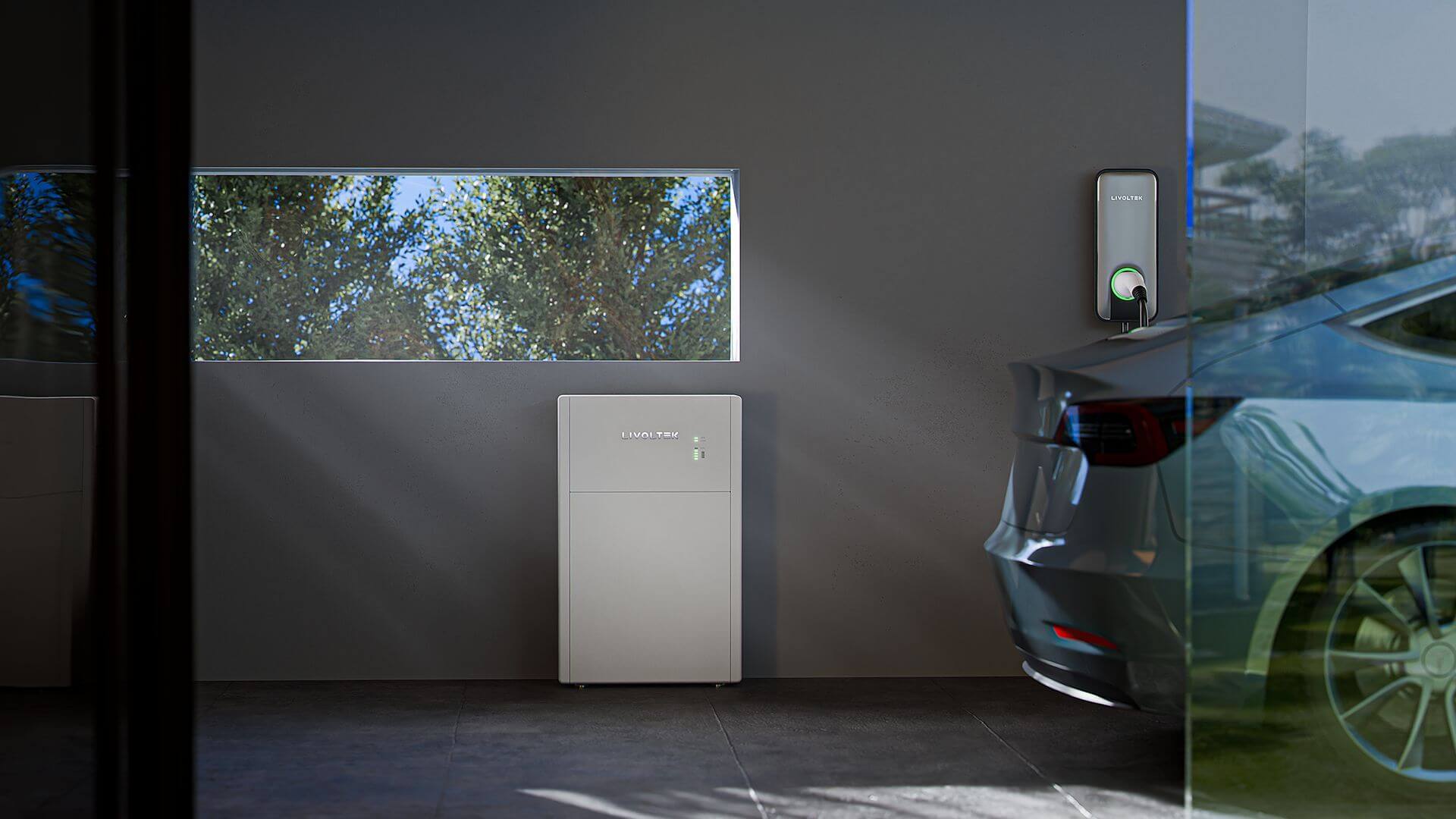
The 5 kWh LIVOLTEK AC-Coupled solution is designed specifically for the vast majority of residential installations in Romania, and is compatible with virtually any existing PV inverter (Fronius, Huawei, SMA, Growatt, Solax, etc.). Installation is quick, without changes to the electrical system, and storage capacity is scalable—start with 5 kWh and add modules as needed.
Efficiency: when math contradicts intuition
“Conversion losses will be huge!” is another common myth. Reality:
In a modern AC-coupled system:
-
AC-to-DC charging efficiency: ~97%
-
DC-to-AC discharging efficiency: ~97%
-
Round-trip efficiency: ~94%
In a DC-coupled “integrated” system:
-
Round-trip efficiency: ~95–96%
Real difference: 1–2%.
For a 10 kWh system charged/discharged daily, that means about 50–100 kWh lost per year. At 0.60 lei/kWh (using the price of energy injected into the grid), we’re talking 30–60 lei/year. In return, the savings from not voiding the inverter warranty and the upgrade flexibility far outweigh these minimal losses.
Romanian winter: where details matter
“What happens at –10°C?” Another fear. LIVOLTEK AC-coupled batteries feature:
-
A BMS (Battery Management System) that protects cells and optimizes charging by temperature.
-
Operation from –10°C to 60°C, storage –20°C to 65°C. Because charging is limited below 0°C (which is usually at night, when PV doesn’t produce), in practice between –10°C and 0°C the system discharges only, and from 0°C up it charges/discharges normally.
Key point: LiFePO4 cells are more cold-resistant than many NMC variants used by pricier batteries. At low temperatures, the system temporarily reduces charge power to protect the cells—but it doesn’t shut down.
One app: finally, a single dashboard
One of the strongest arguments against AC-coupled is the need for “two apps.” LIVOLTEK handles this elegantly by offering:
-
Real-time visualization of PV production, load consumption, and battery state.
-
Smart settings to optimize usage (e.g., night-tariff charging).
-
Notifications and predictive monitoring via SmartCare.
-
Home Assistant integration is in progress—not finalized yet, but planned.
Warranty & support: where serious companies stand out
LIVOLTEK offers:
-
10-year battery warranty.
-
≥80% capacity guaranteed after 6,000 cycles (the equivalent of 16+ years of daily use).
-
Service center in Romania (Timișoara).
-
Romanian-language technical support directly from the manufacturer via https://hexing.ro/ro/contact/
-
Local spare-parts stock.
-
And most importantly: full certifications for grid connection and RePowerEU eligibility.
Conclusion: evolution beats revolution
AC-coupled technology isn’t a compromise; it’s the right architecture for the real problem—adding storage to existing PV systems. Instead of forcing owners to discard working equipment and invest in entirely new systems, AC-coupled respects prior investments, offers future flexibility, and solves the need for storage now—efficiently.
For the tens of thousands of PV systems already installed in Romania, the question isn’t “Why AC-coupled instead of an integrated system?” but rather “Why would I throw away a perfectly good inverter just to gain 1% more efficiency?” The rational answer is simple: you wouldn’t.