
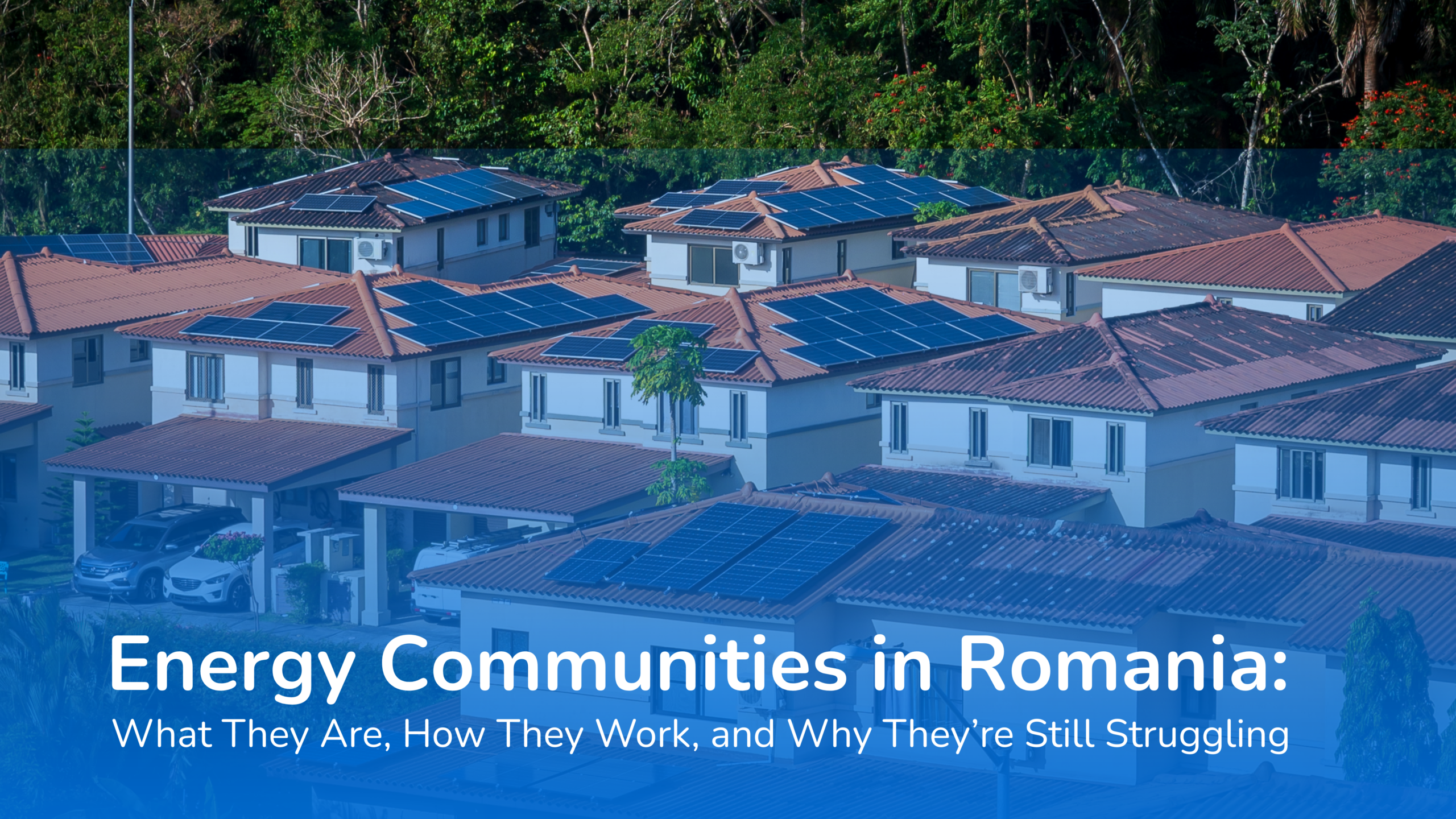
Energy Comunities in Romania: What They Are, How They Work, and Why They’re Still Struggling
Imagine that your apartment building, your neighborhood, or the village where you live could function as a small, independent energy network. Your neighbor with solar panels on the roof generates a surplus at noon. You, who work from home, use that energy in the evening. The elderly woman downstairs, who can barely afford her electricity bill, receives energy at a discounted rate. And the remaining surplus is stored in a shared battery for cloudy days.
It’s not a utopia. It’s the concept of an energy community, and in Romania it became a reality—at least from a legal standpoint—in November 2025. Few people know this, and even fewer understand what it actually means. But those who understand it now have an advantage, especially if they have a storage battery.
Let’s take a look at what energy communities are, what stage the legal framework is at, and why your battery will become the centerpiece of this change.
What, exactly, is an energy community?
An energy community is a group of people from an apartment building, a neighborhood, a village, or an area who come together to produce, consume, store, and even transport energy locally. Instead of each household dealing individually with a large utility provider, community members manage their energy collectively.
The difference from an individual prosumer is significant. A prosumer generates energy for their own use and sells any surplus to the national grid. An energy community creates a local loop: the energy generated by one member can be consumed by another, and any surplus is distributed according to rules established by the community, not imposed by the utility.
In practice, it’s the difference between being an isolated consumer and being part of an energy cooperative. The community can include individuals, small and medium-sized enterprises (SMEs), NGOs, homeowners’ associations, and local authorities. And here’s an important social aspect: communities can offer preferential rates to vulnerable households, helping to combat energy poverty.
The Legal Framework: What Has Happened and What Is Still Missing
It’s important to be precise here, because there’s a lot of confusion in the market.
What has already happened: In November 2025, the government adopted Emergency Ordinance 59/2025, which transposes the European RED III Directive and introduces the concept of an energy community into Romanian law for the first time. The Association of Prosumers and Energy Communities (APCE) described it as “probably the most progressive piece of legislation ever adopted in the energy sector in Romania.”
The adoption was not coincidental: Romania risked an infringement procedure for failing to transpose the European directive and the loss of over 500 million euros from the National Recovery and Resilience Plan (PNRR), funds earmarked for energy communities.
What the law specifically provides: official recognition of the communities through a National Registry managed by ANRE; the obligation for distribution operators to install smart meters, giving priority to community members; open participation, including for vulnerable households; and, crucially, the recognition of storage facilities as part of the infrastructure of national importance. The law explicitly states that renewable energy production, grids, and storage facilities are “projects of national importance in the field of electricity.”
What’s Still Missing: The primary legal framework is in place, but the secondary regulations—that is, the specific implementing rules that ANRE must issue—are still being developed and, in some respects, are the subject of debate. The National Registry was supposed to be operational by the end of 2025, but the process has been delayed, creating tensions between ANRE and prosumer associations. Realistically, the full implementation of energy communities is a process that will unfold throughout 2026 and, likely, into 2027 as well.
In other words: the foundation has been laid, but the building is still under construction. Those who prepare now will be ready when the system becomes fully operational.
How an Energy Community Works Technically
Beyond the legal framework, an energy community needs three technical components to function.
First: distributed generation
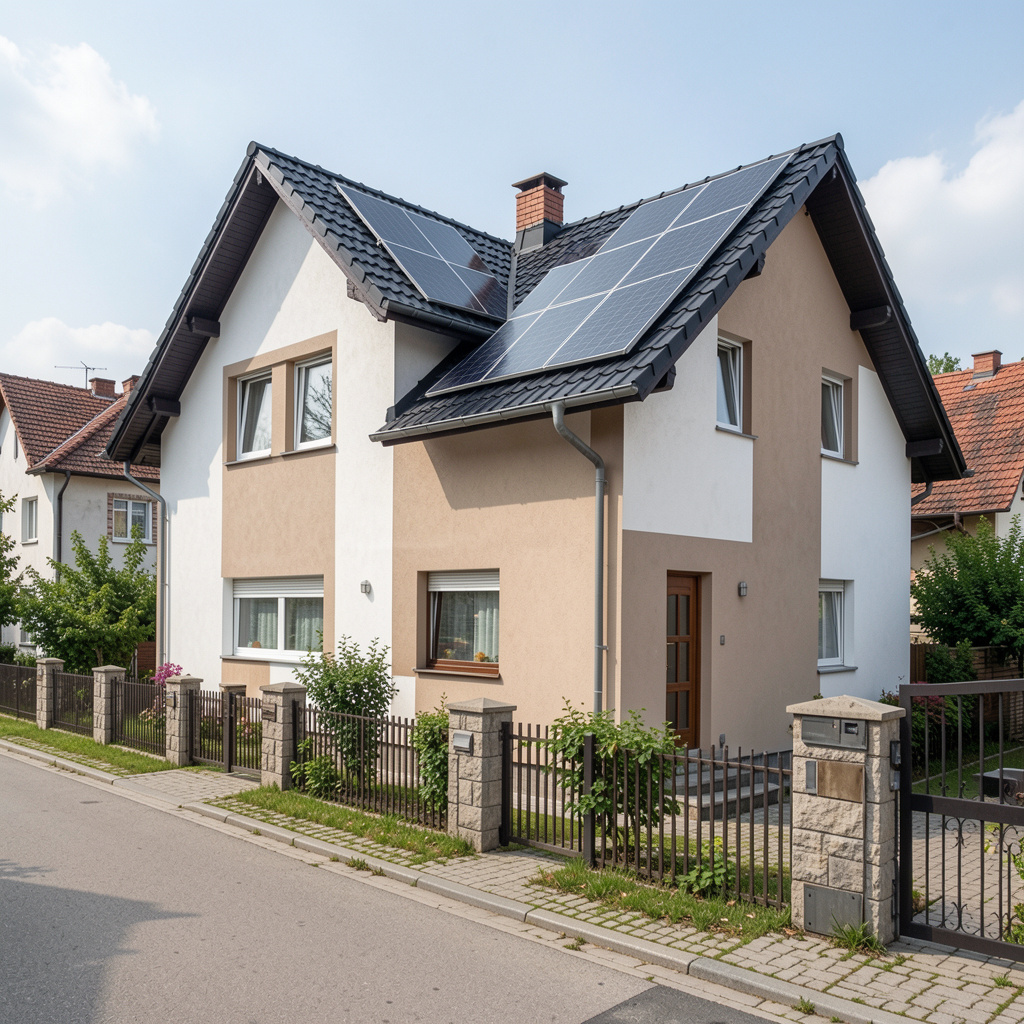
Solar panels on members’ roofs or a larger shared system, such as on the roof of an apartment building or a public building. This is the community’s source of green energy.
Second: smart metering
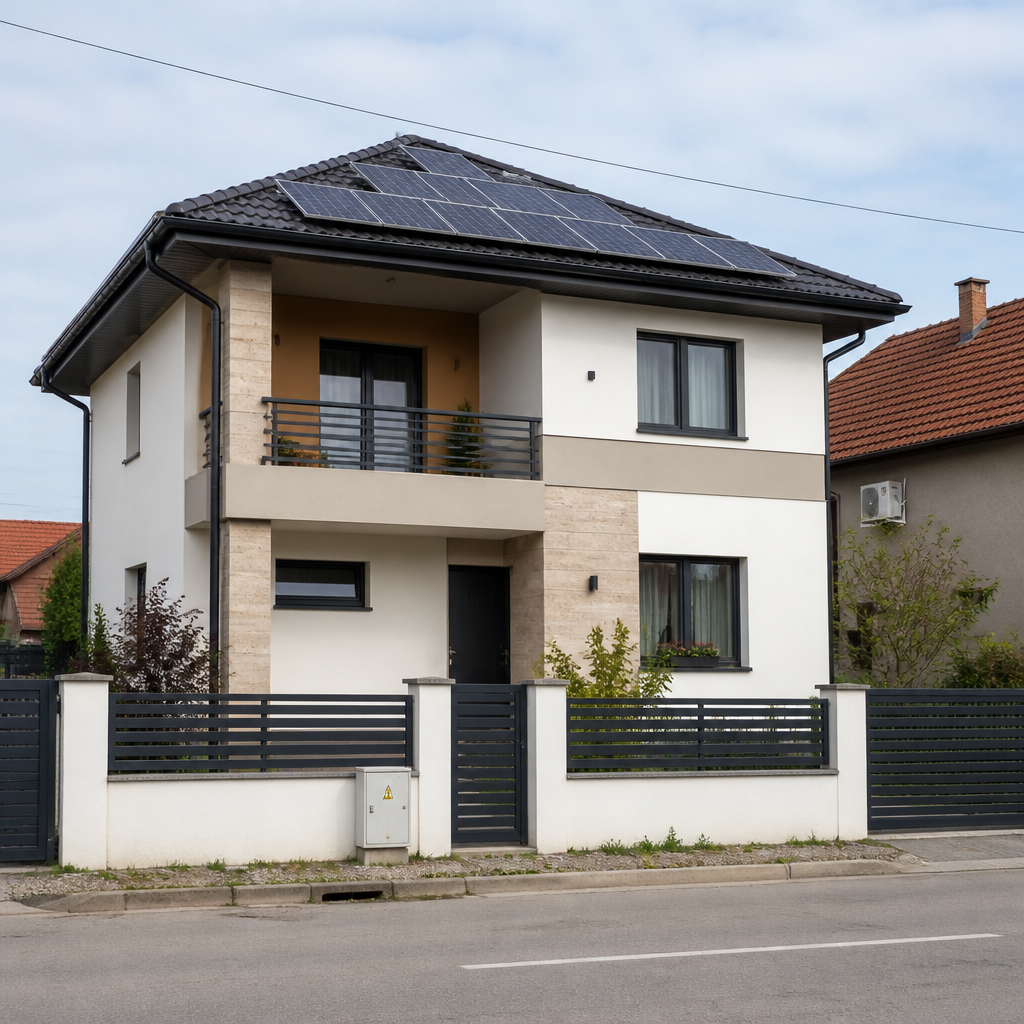
Without them, an energy community cannot function. Smart meters measure in real time who is generating, who is consuming, how much is being stored, and how much is being shared among members. They are the community’s “nervous system,” enabling the accurate billing of shared energy. It’s no coincidence that the law mandates the priority installation of smart meters for community members. Without this metering infrastructure, energy sharing would be impossible.
Third: distributed storage
This is where the battery comes in, and this is the key to the entire system. Solar production peaks at noon, but the community’s consumption is spread throughout the day, with a peak in the evening. Without storage, the surplus from noon is lost to the grid, and in the evening the community buys expensive energy. With storage, the surplus remains within the community and is used when needed.
Added to these three components is an energy management platform—the software that coordinates everything: it decides when to store, when to distribute, how to settle accounts among members, and how the community interacts with the national grid.
Why Your Battery Will Be the “Backbone” of the Community
Here’s the part that few anticipate. In an energy community, the prosumer with a battery is no longer just a consumer who reduces their bill. They become a pillar of the entire system.
Think about the actual mechanics. Solar panels generate power when the sun is out, but the community consumes energy even when it isn’t. Someone has to “hold” the energy between the moment it’s generated and the moment it’s consumed. That someone is the battery. And your battery, connected to the community, no longer stores energy just for you—it can store it for the entire community.
Specifically: at noon, when the community’s solar production exceeds consumption, your battery absorbs the surplus. In the evening, when consumption rises and the solar panels are no longer producing, your battery releases the stored energy back to the community. And you can be compensated for this service. So, not only do you save on your own bill, but you also generate income from your storage capacity made available to the community.
This fundamentally transforms the economics of a battery. Without a community, the battery reduces your bill. With a community, the battery becomes an asset that generates income. The more members who have batteries, the more resilient the community becomes, the more independent it is from the grid, and the more profitable it is for everyone.
Hence the idea that prosumers with batteries will be the backbone of energy communities. It’s not production itself, but the ability to store and release energy at the right time that makes a community function.
The Connection to VPP: From Individual Batteries to a Virtual Power Plant
The concept extends even further, toward what is called a Virtual Power Plant (VPP). A VPP is a network of storage systems in different locations, connected via a software platform and coordinated as if they were a single large power plant. When the national grid needs energy during peak hours, the VPP instructs participating batteries to discharge into the grid. When there is a surplus, the batteries store it.
Romanian law has already paved the way for this model: Government Emergency Ordinance 59/2025 stipulates that ANRE will regulate community participation in grid services. This provides the legal basis for community batteries to participate, in the future, in the national energy system’s balancing market and to generate revenue from this participation.
Essentially, your battery could play three roles simultaneously: powering your home, contributing to the local community, and helping to stabilize the national grid through VPPs. Three sources of value from a single piece of equipment.
The Role of Hexing’s Infrastructure: Smart Meters Are the Foundation
I mentioned that without smart metering, an energy community cannot function. Here, it’s worth noting a detail of direct local relevance.
Livoltek is part of the Hexing Group, and Hexing’s core business—for over three decades—has been precisely the production of smart meters. At its factory in Timișoara—the group’s only factory in Europe—Hexing manufactures the very smart meters that form the basic infrastructure for energy communities.
This is no coincidence, but rather a convergence: Romanian law mandates the use of smart meters as a priority for communities, and Hexing manufactures these meters locally, in Romania. At the same time, Livoltek provides the energy storage batteries that serve as the backbone of these communities. Essentially, both essential components of an energy community—smart metering and energy storage—come from the same group, with manufacturing and support based in Romania.
For a prosumer thinking about the future, this means that investing in a Livoltek battery today isn’t just a solution for today’s bill, but a way to position yourself for tomorrow’s role in the energy community.
What can you do now?
Energy communities aren’t fully operational yet. As mentioned, ANRE’s regulations will be finalized in 2026–2027. But that doesn’t mean you have to wait passively. If you’re a prosumer, the most valuable thing you can do is install a storage battery. When the communities become operational, you’ll already be positioned as a member with storage capacity—meaning you’ll have exactly the profile that brings the most value, both for you and for the community.
And if you’re just starting to think about solar panels, consider a storage-ready system from the get-go—one with a hybrid inverter capable of managing a battery, even if you add the battery later. That way, when you’re ready to join a community, your system will already be compatible.
Livoltek storage batteries use LiFePO4 technology with over 6,000 life cycles; they’re modular (you can start with one capacity and expand later) and integrate natively with hybrid inverters and the MyLivoltek monitoring system. And the AC-Coupled solution allows you to add storage to any existing photovoltaic system, regardless of the inverter brand, making it ideal for prosumers who want to prepare for their role in the community without changing their current installation.
Conclusion
Energy communities represent a paradigm shift. We are moving from a centralized system, in which energy flows in a single direction—from large producers to consumers—toward a participatory model, in which people generate, store, and share energy locally.
Romania took the legal step in November 2025. Full implementation will take some time, but the direction is clear and irreversible, driven by European directives and the technical reality of a grid overburdened by hundreds of thousands of prosumers.
In this new landscape, your battery is no longer just an accessory that lowers your bill. It’s the key that unlocks the door to the energy community and to an active, remunerated role in the energy system of the future.
Whoever has storage has power—literally.
If you want to find out how you can prepare your system for the future of energy communities, a Livoltek-certified partner can conduct an assessment based on your current situation. You can find them at https://hexing.ro/distribution-network/, and the full range of batteries and inverters at https://hexing.ro/our-products/.